
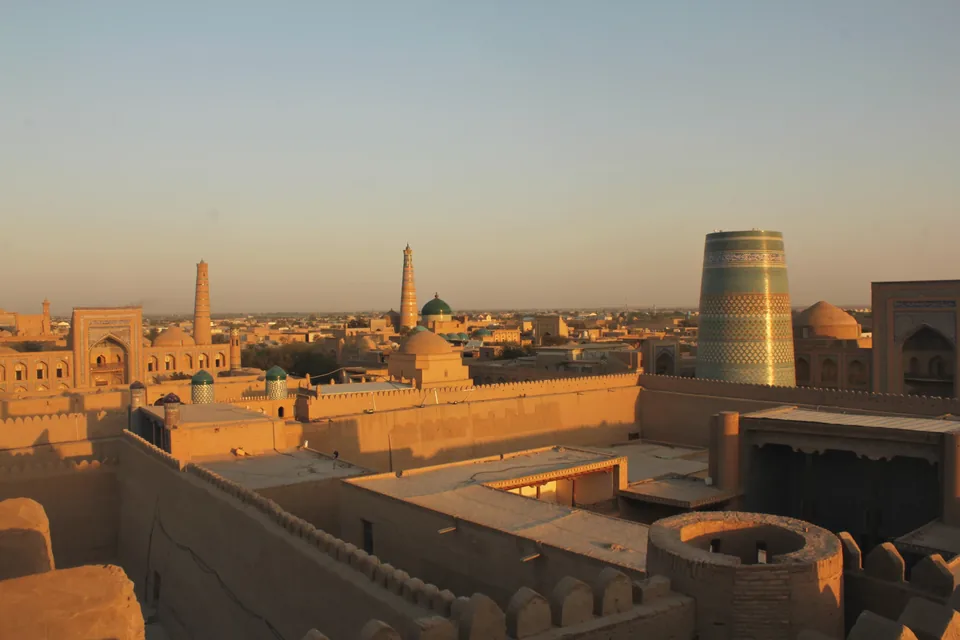

Begin with the whole city
UNESCO describes Itchan Kala as Khiva’s walled inner town: a 26-hectare urban ensemble shaped by more than two millennia of history. Its World Heritage value is not limited to one famous dome or minaret. UNESCO identifies mosques, madrasas, mausoleums, markets, caravanserais and traditional dwellings as parts of a coherent cityscape. Read UNESCO’s description of Itchan Kala.
Start your visit by noticing that relationship. Look at how a narrow street opens towards a monumental building, how carved wooden posts support domestic architecture and how places of worship sit within an inhabited neighbourhood. This turns a walk into an introduction to Khorezm’s urban culture, rather than a race between photographs.
Remember that people live and work here
Uzbekistan’s official tourism portal presents Ichan-Kala as both an open-air historic city and a place where people continue to live and work. See the official visitor overview. Treat doorways, courtyards and workshops as parts of somebody’s daily environment, not as a stage set.
Keep voices low near prayer, avoid blocking entrances and ask before photographing a person at close range. At religious sites, follow posted guidance and local instructions. These simple choices make the experience more comfortable for residents, worshippers and fellow travellers.
Give Pahlavan Mahmud a focused visit
Uzbekistan Travel identifies the Pahlavan Mahmud mausoleum as a revered Muslim pilgrimage place. Its account connects the burial site with a thirteenth-century poet and artisan, while popular tradition remembers him as a hero and healer. The present complex expanded later, including nineteenth-century architecture. Read the official memorial overview.
Keep those layers distinct: the historical person, the devotional traditions surrounding him and the later building all have their own stories. A guide should explain which details are documented and which are transmitted through local tradition. Leave time for quiet reflection instead of treating the memorial as only an architectural stop.
Use a sequence, not a timetable
A useful walking sequence is to begin with the walls and street plan, continue to one major mosque or madrasa, give the Pahlavan Mahmud memorial its own unhurried stop, then finish among craft streets and domestic architecture. This is an editorial suggestion, not a confirmed guided tour. The best order depends on your entrance point, group pace, prayer times and current access.
Choose fewer interiors if your group includes older travellers, children or anyone who needs regular rest. Stone surfaces, steps, heat or cold can change the practical pace. Ask in advance where the group can sit, use facilities and reconnect with the driver.
Confirm what changes from day to day
The sources checked on 13 September 2026 establish the heritage context, but they do not confirm current opening hours, ticket prices, interior access, photography rules or availability of guides in your language for your date. Confirm those details with the responsible visitor service or your guide shortly before travelling.
Ask for the day’s meeting point, walking duration, rest plan and included admissions in writing. If Khiva follows Bukhara in your journey, confirm the transfer separately before fixing the first visit. Ask about a Khiva itinerary