
Start with the object’s label
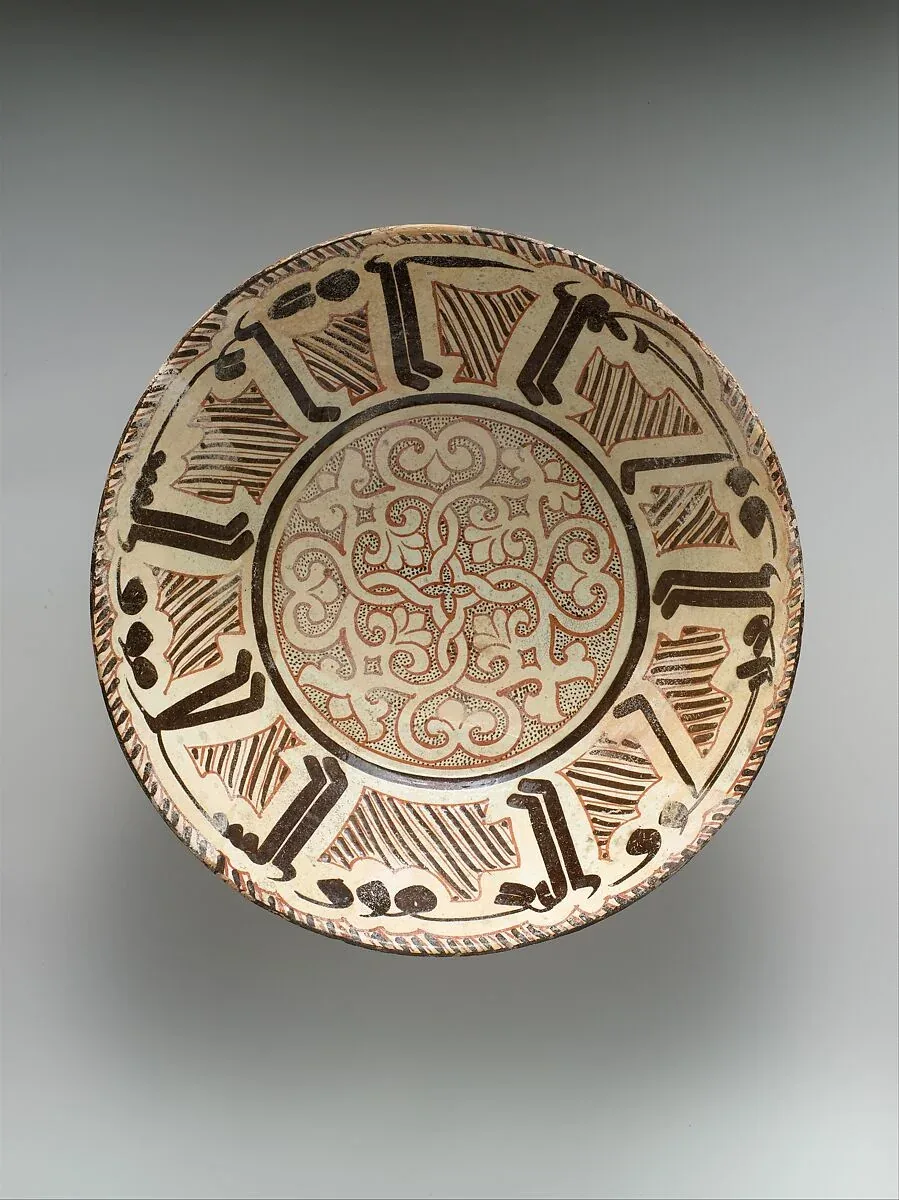
The Met dates the bowl pictured here to the late tenth or eleventh century. Its record says it was probably made in Samarqand, in present-day Uzbekistan, and excavated at Nishapur in Iran. “Probably” matters: the museum is expressing an attribution, not claiming certainty. Explore the object record.
Made in one place and found in another: that distinction gives a small object a wider geographical story. It also reminds us to read a label carefully before attaching an easy Silk Road slogan to everything we see.
Notice how writing becomes design
The bowl’s Arabic inscription expresses good wishes for its owner. The museum notes an unfinished extra word and suggests that its tall strokes helped balance the design. Writing here carries both meaning and visual rhythm.
Try looking twice: first follow the dark shapes around the rim, then ask what the inscription says. A guide or museum label can help with a reading; decoration alone is not enough to identify a text as a Qur’anic verse.
Meet a living craft, not an imagined unbroken past
Rishtan, in the Fergana Valley, is a different setting. Uzbekistan’s tourism portal describes its red clay, flowing shapes, floral ornament and many shades of blue. It also describes teaching through the master–apprentice relationship. Read the official introduction.
The same page presents a thousand-year origin story as legend. A present-day workshop and a medieval museum bowl should not be treated as proof of an unchanged recipe across centuries.
UNESCO records Ceramic arts in Uzbekistan on its 2023 Representative List of the Intangible Cultural Heritage of Humanity. For a visitor, a useful focus is the knowledge and work of the people making ceramics today.
Three questions worth asking a maker
- Who made this piece, and where? Ask about the person or workshop rather than relying only on a city name.
- How should I use and care for it? Confirm whether it is intended for food or display, and ask for the maker’s instructions.
- What is included in the total? Agree packing, delivery and any damage or return terms before paying.
A thoughtful purchase begins with the actual item and its maker. A photograph of a museum object is context for learning, not evidence of what a shop currently has for sale.
Leave time for the conversation
A Fergana Valley craft visit needs its own route and travel time; it is not automatically part of the classic Tashkent–Samarkand–Bukhara itinerary. Ask about the workshop, access and pace before adding a stop.
Tell us about a craft-focused journey. Any workshop visit, transport or purchase needs an individually confirmed arrangement and quote.