

Begin with the documented project
Uzbekistan Travel dates the beginning of Kalta Minor’s construction to 1852, under Muhammad Amin Khan, and says work stopped in 1855 after the ruler’s death. Its separate account of the neighbouring Muhammad Amin Khan madrasa also links the unfinished minaret with the khan’s building programme. Read the official Kalta Minor account.
That gives the tower a clear nineteenth-century setting. It was not an ancient ruin accidentally absorbed into Khiva: it was an ambitious project beside a major madrasa. The official account reports a planned height of about 80 metres and a base diameter of 14.5 metres. Treat the height as the stated intention for an unfinished design, not as a measurement of a building that ever existed.
Let the unfinished shape become evidence
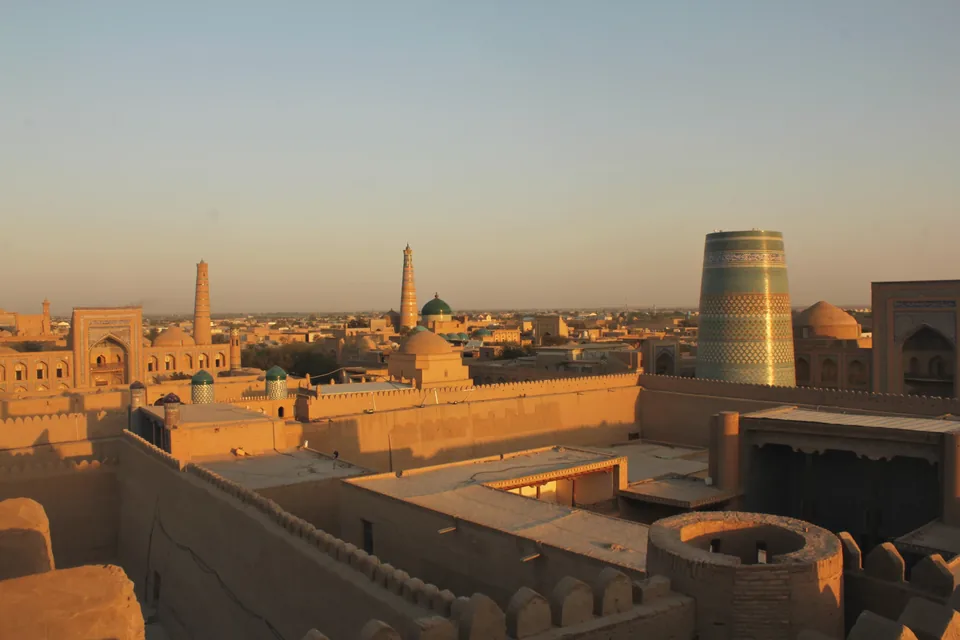
The surviving structure is short, extremely broad and visually complete at ground level, even though the tower itself was not completed. Uzbekistan Travel describes it as covered with glazed tiles and majolica. Look closely at the horizontal bands, the changing turquoise tones and the relationship between the decorated cylinder and the madrasa façade.
Resist the temptation to draw the missing upper half in your imagination as though its exact appearance were known. Instead, compare the unusually wide base with Khiva’s slender Islam Khoja minaret elsewhere in the city. The contrast shows two very different architectural ambitions without requiring a speculative reconstruction.
Keep the escaping-architect story labelled as legend
The official tourism page explicitly introduces another explanation as a legend: an architect supposedly agreed to build a similar tower for the ruler of Bukhara, learned that punishment awaited him and fled Khiva. It is an engaging story, but the source does not present it as documentary proof.
Share it as part of the monument’s cultural memory, then return to the firmer sequence: construction began under Muhammad Amin Khan and stopped after his death. Separating the two does not make the legend unimportant. It lets a traveller understand why the story is repeated without confusing repetition with historical verification.
Place one landmark back inside the city
UNESCO’s World Heritage record describes Itchan Kala as a coherent urban ensemble rather than a collection of isolated icons. The property includes mosques, madrasas, mausoleums, houses, markets and minarets; its value also lies in how major nineteenth- and twentieth-century buildings fit an older street pattern. Read UNESCO’s Itchan Kala record.
Kalta Minor works best as an entry point to that larger composition. Notice the western gate, the adjacent madrasa and the way a highly visible tower helps orient movement through narrow streets. Then look beyond it: a famous photograph can begin a city reading, but it should not replace one.
Use ten attentive minutes before moving on
Stand far enough away to see the base and the madrasa together. Move closer to study the tile bands, then ask your guide which statements come from inscriptions or records and which come from local tradition. This small routine turns a quick photo stop into a lesson about patronage, design and memory.
The sources checked on 8 October 2026 do not establish current interior access, climbing access, ticket conditions, opening hours or photography rules for your date. Confirm those details locally and do not build an itinerary around access that has not been verified. Request a four-city Uzbekistan plan with your dates, group size and preferred Khiva pace; transport, guide, hotel and any optional craft visit require written confirmation.